Independent FDE · AI implementation

Put AI to work.
Keep the capability in your team.

Connect your AI tools to a real business process, with clear ownership from the first decision to the final handover.

I help IT and operations build a managed AI foundation, implement focused workflows and prepare a small internal AI group to run and improve them.

Company-owned tools. Connected business workflows. An internal team prepared to take over. Illustrative architecture.
  • Company-owned tools
  • Human review by design
  • Remote delivery in English

From consulting material to a concrete workflow

See the cross-border operations playbook.

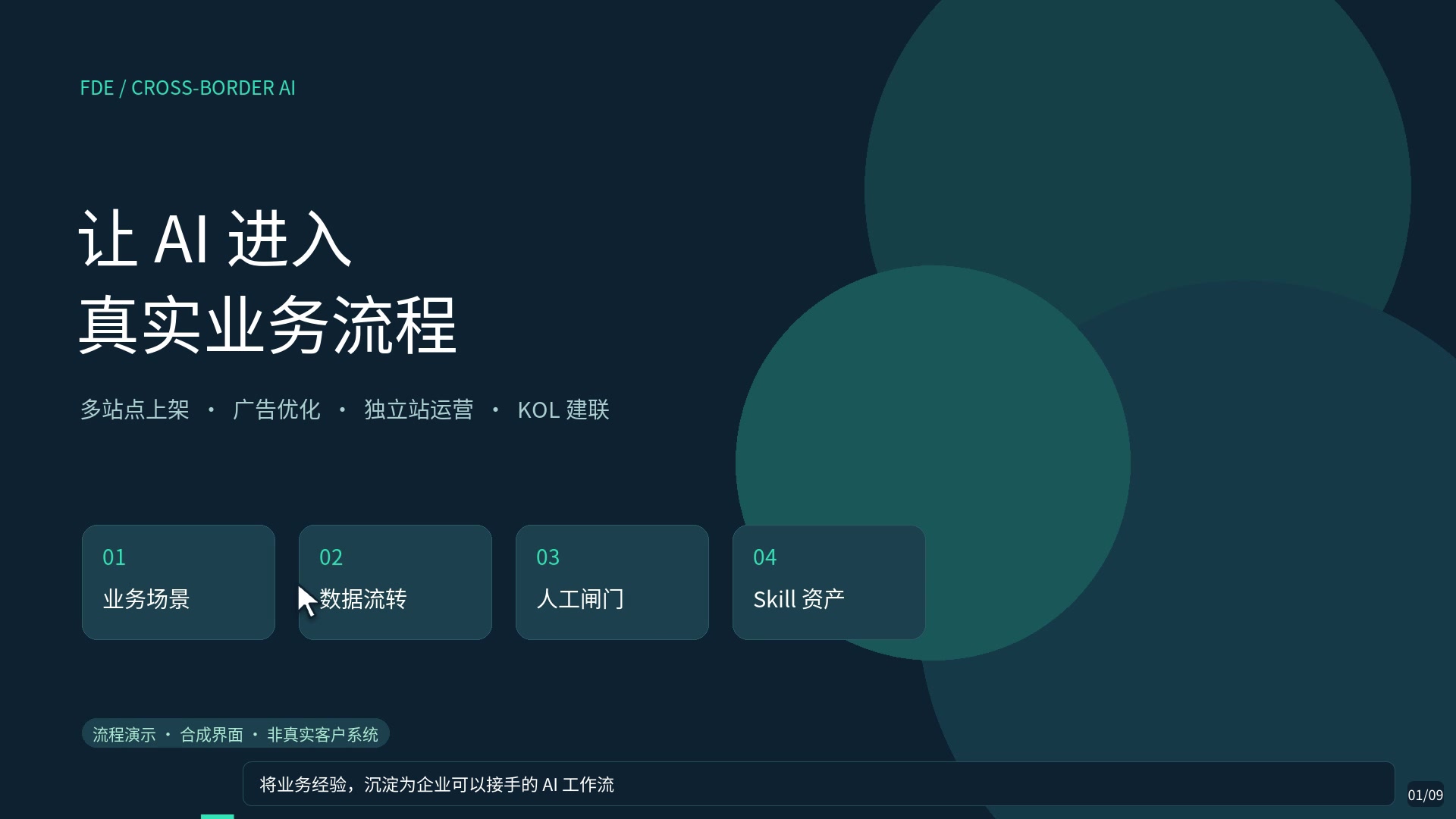
A 76-second click simulation, four scoped workflows and the evidence your team would receive. Synthetic demonstration; no customer performance claims.

Explore the case & videos ↗
Synthetic workflow demonstration cover▶   01:16 · Synthetic demo

From AI adoption to operational capability

The tools are only the beginning.

AI becomes useful when it fits the way your business actually works: the systems people use, the decisions they make and the exceptions they handle. I work alongside your IT and business owners to connect those pieces, then help a small internal AI group take responsibility for the system.

Delivered work · shared with permission

Design tools. Office systems. One connected workflow.

An anonymised project connects design SaaS and office work through Codex, with company-specific Skills preserving reusable procedures and business-data handoffs.

Read the project overview · English

Architecture shared with permission. Client identity and numerical business outcomes are not disclosed.

Design SaaSOffice systems
Codex
Company-specific SkillsOperate → review → improve

Services

Infrastructure. Workflows. Your own AI group.

Choose a focused entry point. The work connects technical foundations, business implementation and the people who will operate the result.

01

AI infrastructure

Make AI a managed part of your IT.

Connect eligible company-owned accounts, API plans and seats with clear permissions, budgets and accountability.

  • Tool and model integration; identity and access boundaries
  • Credential handling, usage budgets and audit trails
  • Operating notes, failure handling and a practical handover
02

Business implementation

Take a workflow from input to operation.

Map the actual handoffs, connect the tools and test the exceptions. Keep business rules and human decisions visible.

  • A scoped workflow with inputs, outputs and an owner
  • Integrations, approval gates and evaluation examples
  • A pilot, operating runbook and agreed acceptance checks
03

Team enablement

Build your own 2–4-person AI group.

Help a small internal group use, maintain and improve the workflow after the engagement.

  • IT, a process owner and internal champions; roles may overlap
  • Hands-on training using your real operating procedures
  • Evaluation habits, incident ownership and an iteration backlog

Work & case studies

See the work move.

Six concrete starting points. Follow the source, the decision and the handover your team would own.

Business workflows

Inside a working AI workflow.

Choose a business situation. Follow the handoffs. See exactly where a person makes the decision.

Synthetic walkthrough · no live systems
System01 / 05

Check the product source

Match the SKU and source revision before drafting.

Input

L-204 · sheet r2 · aluminium · 36 cm

Output

Source accepted; dimming is not stated.

Explore the workflow

Ready to explore

Illustrative data only. No external system is connected and no action is sent.

Your AI group

Build the team that takes the work forward.

Your internal AI group is the centre of the operating model. IT, the process owner and internal champions work together to run the workflow, assess its quality and prioritise improvements.

Your AI group
2–4

people, with roles sized to your team

Business sponsor

Sets priorities and decides which process deserves the next investment.

Access, integrations, budgets and recovery.

Rules, exceptions, acceptance and external commitments.

Daily operation, examples, colleague support and feedback.

IT owner — Access, integrations, budgets and recovery.

Run → inspect → resolve → improve

  • A reviewed operating record
  • A growing evaluation set
  • An owner-approved improvement backlog

One person can hold more than one role. The 2–4-person structure is a proposed operating model, adapted to the company.

01 — 03

A clear route from problem to ownership.

  1. 01

    Understand

    One recurring task, its tools, constraints and a useful result.

  2. 02

    Build & check

    A limited pilot, realistic examples and explicit review gates.

  3. 03

    Transfer & improve

    Working notes, team practice, acceptance checks and next steps.

Before you commission a project

Make the important decisions early.

Three practical guides to help a business owner and IT agree what to build, what access to provide and who will run it. The resources are in English.

FAQ

Before we start

Do we need to replace our systems?

Usually the first step is one handoff between tools you already use. We check available APIs, permitted browser paths and data quality before selecting an implementation.

What can we start with?

One recurring task, its main tools and a few permitted examples. A focused assessment defines the boundary, useful output and acceptance checks for a pilot.

Is every action fully automatic?

No. Drafting, retrieval and record preparation can often be automated. Your process owner decides which production writes, customer messages or commercial decisions need approval.

How do CC Switch and Sub2API fit?

They may be evaluated as components where their features, licenses, security and provider terms fit. The foundation is eligible company-owned seats and APIs, clear access and usage ownership—not shared personal subscriptions.

What happens after the handover?

A small internal group practises running, checking and recovering the workflow. You receive operating notes and evaluation examples; any continued support is scoped separately.

Who delivers the work, and in which language?

Chen Xulin works independently and remotely in English. These pages have six language versions; total capacity is 40 hours per week across engagements. Fees, dates and scope are agreed in writing.

One independent practitioner. Working with your team.

I’m Chen Xulin (陈旭林), publicly known as Leon S Kennedy: an independent FDE engineer and AI implementation consultant. I work remotely in English, with 40 hours per week total capacity across engagements. Scope, timing and meeting overlap are agreed together.

These pages are available in six languages. Project communication and delivery are in English.

↗ Discuss a project

Which workflow deserves a closer look?

Discuss your workflow

These pages are available in six languages. Project communication and delivery are in English.